In Falsus Iota and Card Integration
Blueprints are puzzles. Cards are loadouts. Neither replaces hitting the notes.
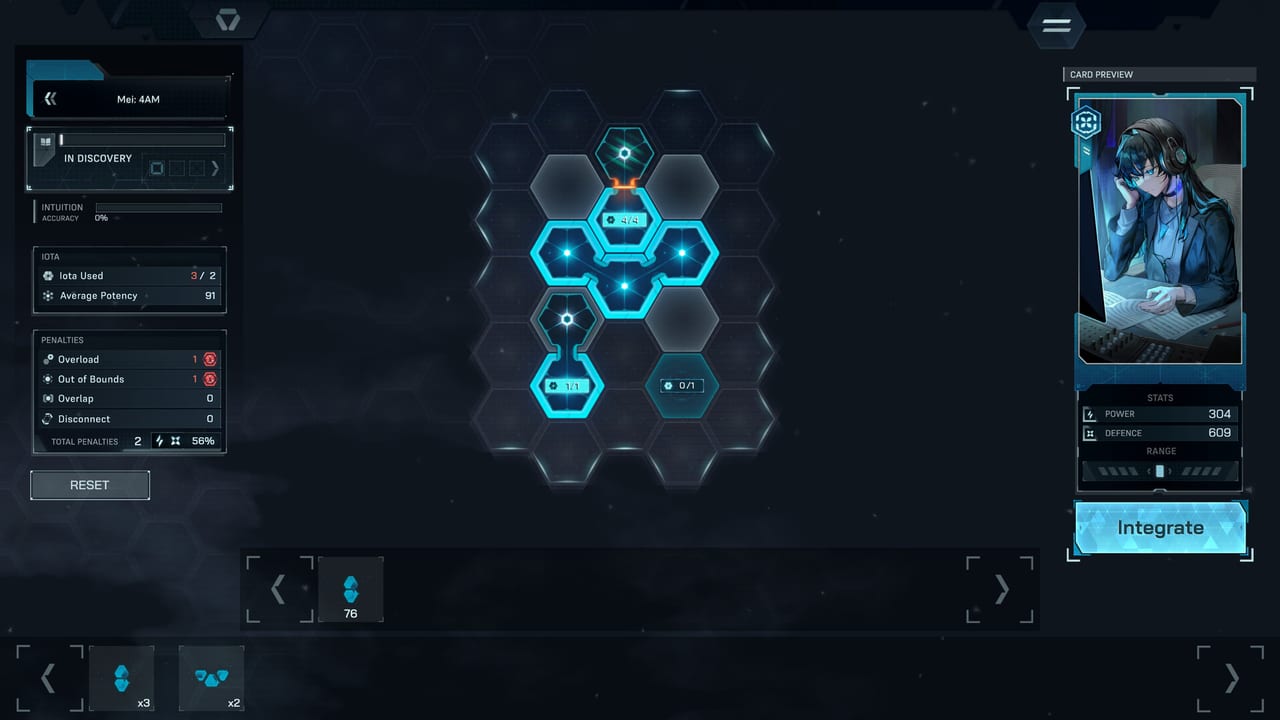
Card Integration is the third genre in lowiro’s pitch: music game × card crafting × ADV. You clear songs, collect Iota, slot those pieces into Blueprint hex grids, and Integrate a Card with its own art, stats, and story fragment. During charts you may equip up to five Cards. Their contribution is a separate score path, which is why the play HUD can show a giant performance number and a smaller Encounter Score with stars.
The Steam demo’s 0.3.0 update is the first time most players can touch this lab. Treat it as a tutorial puzzle, not a finished collection. Official launch copy still promises more Blueprints, more Iota shapes, and cards illustrated from characters you meet.
The loop in one paragraph
Play a chart. Earn Iota. Open Blueprints / Cards / Iota. Pick a Blueprint such as “Mei: 4AM.” Place polyomino-like Iota shapes on the hex field. Watch penalties. Press Integrate when the preview stats look acceptable. Equip the card in a five-slot loadout. Play another Encounter and see whether Power, Defence, Range, or Iota Limit actually changed how the fight felt.
If that loop ate an hour, you are over-optimizing a demo. Integrate one card, then go back to controls.
Reading the Blueprint screen
Store screenshots of the hex lab show the real labels. On the left: status (In Discovery), Intuition, Accuracy, Iota Used (for example 3 / 2), Average Potency, and a penalty stack. Penalties observed in the preview include:
- Overload — you spent more Iota than the current limit likes.
- Out of Bounds — a piece hangs off the legal hexes.
- Overlap — pieces share a cell they should not.
- Disconnect — the shape is not a legal connected placement.
Total Penalties and a percent sit under that list. A Reset button exists because the studio expects you to fail the puzzle. That is the point: every Blueprint is a different grid, and how you complete it changes the resulting card’s effects.
On the right, Card Preview shows art and stats. Demo numbers on “Mei: 4AM” include Power 304 and Defence 609 while the placement is still dirty, then cleaner totals such as Power 600 and Defence 1400 with Iota Limit 2 (Max: 6) on the inspect panel. Range is a bar, not only a number. Traits can be filtered later: In Discovery, In Mastery, Mastered, No Traits, With Traits.
Iota Limit matters because Nia’s character panel already shows a Core Skill named Expanded Iota Limit. Characters and cards talk to each other. Do not treat the five girls as visual-novel skins glued onto a rhythm ROM.
Discovery versus Mastery
The inspect view draws a track from Discovery into Mastery. Demo cards start In Discovery at 0 percent. You are looking at a progression rail, not a rarity gacha. Play Encounters, improve placements, and let the card graduate. We do not invent drop rates because this is not a gacha game.
Loadouts in a live chart
During Hyaloüyne you can see card portraits stacked on the left of the playfield. Those are the five-card cap in motion. Official store text: equip up to five Cards to vary your approach when challenging songs. Card artwork depicts characters met and narrative moments witnessed, drawn by a roster of illustrators.
Two scores then exist:
- Accuracy performance — timing on Floor and Field, the big number.
- Card / Encounter contribution — the side number with stars.
Chasing only the big number is how rhythm players ignore the system. Chasing only stars is how VN players ignore the chart. Do both, lightly, in the demo.
How this ties to Encounters and story
Iota is not gold. Official site copy: clear songs to collect Iota, slot them into Blueprint grids, gain advantages against stronger threats in the Scenario. An Encounter is a story fight with a unique song. Cards are how the story’s relationships leak into the playfield. Read encounters next if the HUD’s dual scores still feel like a bug.
Character pages note hobbies and voice actors; they also hint why a card named “Mei: 4AM” looks like a girl in headphones at a mixer. Mei performs, lives alone, and would rather talk movies than music. The card is a fragment of that life, not a random SR.
Demo limits and launch expectations
You will not craft the full launch binder in 0.3.0. You will learn the verbs: place, penalty, Integrate, equip, Encounter. On September 9 the collection should balloon with the rest of the 70-plus tracklist. Until official numbers land, do not copy a spreadsheet that claims launch Iota tables.
If the hex UI is the blocker, watch the official Card Integration showcase in the middle of this article, then place two pieces and stop. Perfectionism belongs on EXACT timing, not on a preview grid.
Frequently Asked Questions
Quick answers for demo players and launch-week questions.
Do cards replace hitting notes?
No. Timing still drives the main score. Cards add a parallel Encounter value and in-chart advantages.
What is Iota?
The material you earn from clears and spend on Blueprint grids. Overusing it relative to Iota Limit causes Overload.
How many cards can I equip?
Up to five per official store text. The play HUD stacks their portraits on the left.
Is this a gacha?
No. You craft from Iota and Blueprints. There are no redeem codes; see links for official news only.